Customer Service Experience Handbook for 2026
Our 2026 handbook on building a customer service experience that leads to loyalty and retention.
Written by Irina Maltseva

At a time when customers have endless choices, how you treat them can make or break your business. They might forget the discount or the clever ad that got them to buy, but they will never forget how your brand made them feel.
That’s why customer service is no longer just another business expense. It’s a growth engine, a revenue-generating asset. But…only if it’s done right.
Follow along as we explore everything you need to know about engineering a customer service experience that turns your customers into loyal brand advocates and ensures long-term business success.
What is customer service experience?
Customer service experience refers to how people feel during and after a customer interaction with your support team. This applies to any business, from ecommerce stores to SaaS platforms, and can happen via phone, email, live chat, or social media.
Customer service experience is a subset of the broader customer experience (CX), which includes every single interaction and touchpoint a customer has with a brand – from initial brand discovery to the purchasing process, product use, and ultimately, customer support.
The reason customer service experience stands out is that it’s a high-stakes moment when the relationship is tested. When customers contact support, it’s rarely because things are going perfectly. More often, they’re confused, frustrated, or even angry.
So you’re not just resolving an issue (that’s the basic expectation). You’re also resolving feelings. This is what will create loyalty and advocacy through customer satisfaction. And it’s the reason everyone all the time emphasizes so much on the customer service importance.
Why does great customer service matter for business success?
Great customer service sets the foundation for the three biggest drivers of business success: loyal customers, good reputation, and differentiation.
-
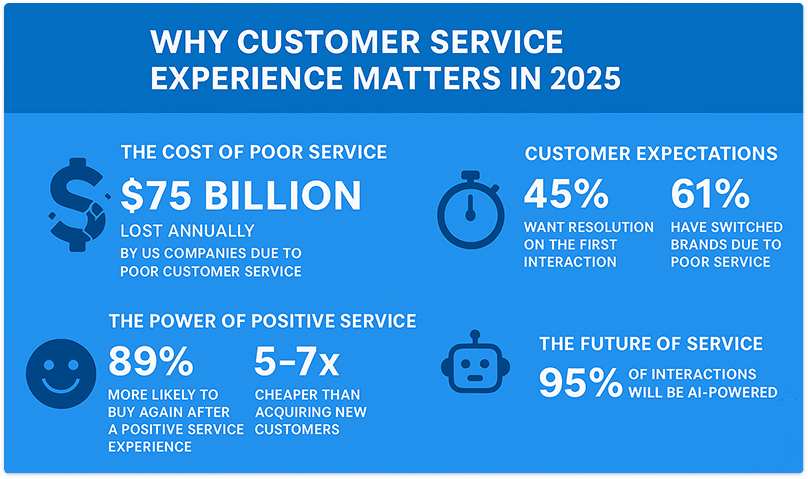
Customer loyalty and retention. According to research, 89% of customers are more likely to make another purchase after a positive service interaction. On the other hand, 64% have switched brands due to poor service.
And here’s the thing: when you lose one customer, you don’t just lose a single sale. You lose their lifetime value. If your product or service costs $500 a year, it can mean missing out on $3,000-$5,000 in lifetime value – not counting referrals they might have made.
This is why retention matters. -
Reputation management. Satisfied customers tell three friends, angry customers tell 3,000. An interesting book title that tells an unfortunate truth. A positive experience creates happy customers who will willingly promote your brand. However, bad experiences create dissatisfied customers who will go the extra mile to express their frustrations.
I once worked with a vendor that had slow, disorganized onboarding, nothing dramatic, just frustrating. I mentioned it to a few people when they asked about the tool, and within weeks, I started hearing the same opinion echoed back to me from completely different circles. That’s when I realized how fast negative experiences travel compared to positive ones.
That’s the ripple effect of customer service. - Competitive Differentiator. If you’re in a crowded market, you cannot rely on the quality or price of your product to differentiate it from the others. The margin for standing out is small. This is when the quality of your customer service experience and customer care becomes your unique selling point.
What makes a good customer service experience great: a short guide
These four qualities are what elevate ordinary support into a great customer experience:
Empathy and active listening
Empathy in customer support is one of the important customer handling skills. It means understanding not just customer needs, but their pain points, what they’re feeling, and why the situation matters to them. As a result, customers feel heard and valued, which builds trust and loyalty.
Better yet, empathy helps the customer service team uncover underlying issues the customer may not have explicitly mentioned, leading to a more informed and effective solution.
Speed and accuracy
Fast, reliable support is one of the clearest signals of an exceptional customer service experience. People don’t just want quick replies; they want quick solutions. Delays, repeated handoffs, or having to restate the same issue and ask the same questions multiple times quickly erode trust.
That’s why resolving issues during the first interaction (often called First Contact Resolution, or FCR) is so important for a good service experience. When consumers get accurate help the first time, satisfaction increases while support teams reduce the time and cost spent on follow-ups. It increases the overall customer lifetime value.
Personalized interactions that go beyond the script
While scripts can be helpful for consistency and satisfying customer expectations, people appreciate it when businesses recognize them as individuals, not just tickets in a queue. Use their names, reference past interactions, offer unique, tailored solutions, and anticipate their needs even before they’re voiced.
This turns a transactional moment into a human one. However, it’s a thin line between a personalized experience and an invasion of customer privacy. It’s important to emphasize this during customer service training exercises.
Omnichannel support that feels seamless
The modern customer journey is no longer linear. It is a complex, multi-touchpoint path where a customer might start a query about product or service issues on social media, follow up via live chat, and then receive a resolution email.
An effective omnichannel strategy ensures that this journey feels unified and effortless. The customer doesn’t need to repeat themselves because the customer service agents have access to the full history of the previous conversation. This is unlike the traditional multichannel approach, where channels operate independently. Such consistency builds a positive feeling of deeper customer relationships.
Real examples of great customer service experience
Here are three iconic examples of businesses that have learnt to harness the power of a favorable customer service experience to their advantage.
Zappos: The 10-hour call
Zappos is one of the companies that has successfully leveraged a positive customer service experience to grow immeasurably. Perhaps no story exemplifies that more than the customer service call that lasted over 10 hours.

What began as a normal shoe-order call turned into a nearly ten-hour conversation about a customer’s move to Las Vegas, with the agent giving real-life advice on neighborhoods, jobs, and schools.
It’s the perfect case study for personalized interactions that go beyond the script and how that translates to revenue growth and customer loyalty.
Amazon: Speedy resolution at scale
Amazon is the world’s largest online retailer, serving millions of customers daily. Yet despite its scale, Amazon has managed to uphold a reputation for fast, accurate problem resolution.

If a package is lost, late, or broken, customers often receive prompt refunds or replacements with minimal hassle. For those selling dropshipping products, adopting similar quick resolution practices can significantly boost customer trust and satisfaction.
The Ritz-Carlton: Joshie the giraffe
The Ritz-Carlton is also renowned for its great service, but one viral story illustrates its commitment perfectly. A guest’s child accidentally left behind a stuffed giraffe named Joshie. To comfort his son, the father told him Joshie was simply “staying on for a little extra vacation.”

Upon hearing the story, the staff decided to bring the story to life, demonstrating remarkable empathy. They took photos of Joshie lounging by the pool, working in the spa, and exploring the hotel, before sending back the toy.
The story went viral, enhancing Ritz-Carlton’s reputation worldwide and showing how small acts of empathy can create a lasting impact.
How do you build an excellent customer service experience?
Creating an excellent customer experience requires a deliberate strategy, the right tools, and a culture that prioritizes the customer. Here are six key practices to guide the process:
Respond quickly and proactively
To put this principle into practice every day, you need a structured approach to all your support processes and communication channels. Key actions include:
- Immediately acknowledge the customer concern: Use chatbots or automated replies to confirm queries instantly, then escalate to a human when needed. Set reasonable waiting times to address the complaint.
- Be proactive: If there’s any delay in resolving the customer issue or you need additional details, reach out without them having to follow up.
- Social media monitoring: Monitor social media and review sites to address concerns before the customer escalates them to the support team.
Collect customer feedback and act on it
You shouldn’t just collect and forget feedback, making it a senseless ritual; it should become part of your business. How to put this into practice:
- Ask often: Use short post-interaction surveys, star ratings, or NPS (Net Promoter Score) to gather customer insights.
- Spot trends: Track recurring complaints or customer inquiries to identify process improvements.
- Close the loop: Let customers know when their feedback led to a change.
A company that says, “We updated our app based on your feedback,” instantly reinforces customer loyalty. You can even take this a step further by using AI agents to automate parts of the workflow, coordinate multiple actions, and continuously learning to improve efficiency.
Build a customer-centric culture
A customer-centric culture must be a top-down, business-wide commitment. Key tips to follow:
- Lead by example: Leadership should demonstrate customer-first behavior in every decision.
- Empower employees: Give staff the authority to resolve issues without endless approvals.
- Celebrate wins: Share stories of great service internally to reinforce desired behaviors.
- Measure what matters: Track customer experience KPIs (like customer satisfaction score, loyalty, etc.) alongside traditional KPIs like revenue.
Offer customer support team training regularly
When agents are empowered, valued, and well-trained, they are more motivated and able to deliver exceptional service. Tips to follow:
- Refresh often: Run short, ongoing training sessions or host internal webinars instead of one-off events.
- Mixed skills training: Cover both hard skills (systems, product updates) and soft skills (empathy, communication).
- Use real cases: Train with actual customer scenarios so agents practice handling real challenges.
- Track progress: Review support metrics and customer feedback to spot skill gaps and tailor training.
Continuous training keeps teams sharp and ensures service quality stays consistent as your business grows.
Use AI and automation wisely
The most successful organizations are not replacing humans with AI but using a smart hybrid model that creates a symbiotic relationship between the two. Tips to follow:
- Customer-facing AI: Use chatbots and virtual assistants to provide 24/7 answers for repetitive queries (order tracking, FAQs). This can cut service costs by up to 25%. For phone support, use auto-attendants to receive customer calls during offline hours.
- Agent-facing AI: Equip customer service representatives with tools that auto-route tickets, suggest responses, and create case summaries. Businesses that do this save an average of 1.2 hours per day.
- Human in the loop: Automate the simple stuff, but ensure smooth handoffs to humans for sensitive or complex cases.
- Audit regularly: Monitor AI performance to prevent frustrating loops or incorrect responses.
Using AI in customer service wisely will help free up humans to do what they do best – handle nuanced interactions that need emotional intelligence.
Protect customer safety, identity, and privacy
People in general like to feel comfortable sharing their data with other people, right? They want to know how seriously you take that responsibility. Here’s how to build customer trust and loyalty through privacy and security:
- Be transparent: Clearly explain how customer data is used and stored.
- Layer your defenses: Use encryption, multi-factor authentication, and regular audits to prevent breaches.
- Customer awareness training: Educate your customers about basic online hygiene practices. For instance, how to check their online footprint and how to remove sensitive data from the public domain.
- Act fast when issues arise: If a breach happens, notify customers immediately with clear next steps and available protections.
When combined, these practices form a customer service playbook that scales with your business while staying human at its core.
Conclusion
In summary, a great customer service experience combines empathy, efficiency, and expertise. It requires treating every support interaction as an opportunity to build loyalty. As research shows, satisfied customers are far more likely to stay with you and recommend you, while poor service drives them away.
By training your team, listening to feedback, and leveraging technology to be both fast and personal, you’ll turn routine support into a competitive advantage, a reason customers choose you again and again.