“Sorry for the Inconvenience”: 10 Better Alternatives to Say It
Learn all the original equivalents to the phrase "sorry for the inconvenience" and use them in your next customer service interaction!
Written by Kateryna Havrylenko
Things go wrong. A system crashes at the worst possible moment, a client’s package gets lost, and an invoice charges the wrong amount. It happens to every business, but what separates the good ones is what they do next.
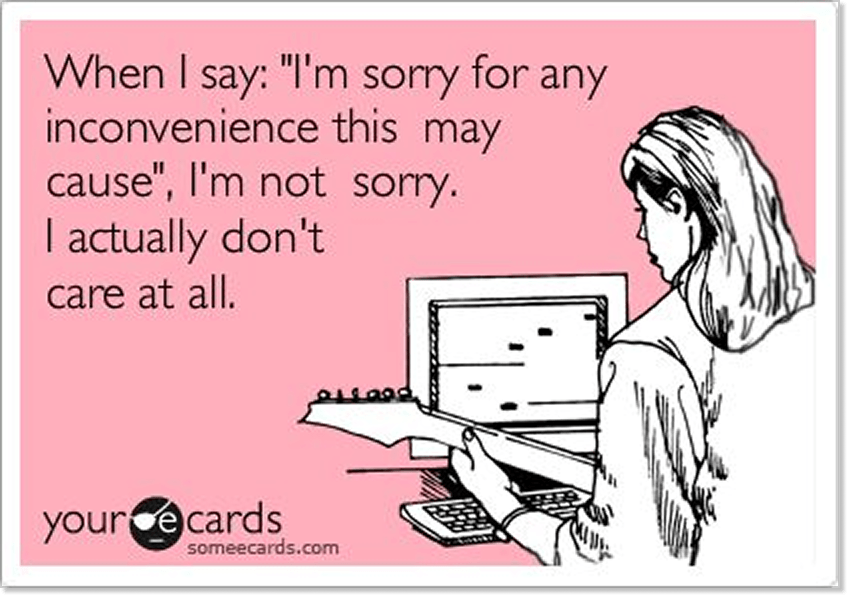
The phrase “sorry for the inconvenience” has become a robotic, impersonal, and dismissive non apology. The phrase is so overused that it’s lost its meaning. In the customer service industry, people interpret it as “We know we messed up, though you have to put up with that”. That’s why you have to quit using this line left and right.
As a business owner prioritizing customer loyalty and retention, you can’t afford to sound like a script. To keep your audience, you need to swap clichéd lines for empathy statements for customer service, authenticity, and ownership. This complete guide will show you exactly how to do that.
What does the “sorry for the inconvenience” phrase mean?
“Sorry for the inconvenience” is a phrase used to acknowledge a mistake (something you did, or failed to do) that caused a customer real frustration and led to a bad experience. In customer service, it’s meant to signal accountability and empathy while preserving customer loyalty and retention.
Why a generic apology doesn’t work
Let’s start with the phrase itself. “Sorry for the inconvenience” has been around so long that most customers read it on autopilot. It signals a scripted response rather than genuine care.
Here’s why it keeps missing the mark:
Ruins the trust
Most clients recognize it instantly and think a customer support team may just copy-paste response, even in an email broadcast. Don’t do that, change the system!
It minimizes the problem
What feels like a small slip to your team can feel like a big deal to your customer. Downplaying it (even with good intentions) reads as dismissive. Customers don’t want excuses, they want acknowledgement and a clear next step.
Shows zero understanding of the actual problem
Let’s call a spade a spade: “Sorry for the inconvenience” may sound a bit callous. In most cases, this is true without a follow-up letter. Do you want an already frustrated customer to feel like their complaint didn’t even register?
No urgency to provide help
One of the first rules of service is solving customer complaints ASAP. A good apology shows urgency. If the message doesn’t include a next step, it signals you’re not willing to fix anything.
And the consequences go further than a single unhappy reply. One bad experience rarely stays contained. It shapes how customers talk about you, or whether they come back at all. Dissatisfaction spreads through reviews and word-of-mouth faster than almost any marketing campaign. Trust, once lost, takes real effort to rebuild. And even loyal customers start looking elsewhere when they feel consistently brushed off.
Now that we know what’s at stake, let’s get into the actual language and the templates you can use right now.
Better alternatives to “Sorry for the inconvenience”
I want to provide you with alternative ways of saying “sorry for the inconvenience” without actually pronouncing these words (substituting them with both formal and less formal synonyms).
Pick what fits your tone and the situation:
Take direct responsibility
- This is unacceptable, and we realize we let you down.
- We shouldn’t have done that. The fault is 100% ours.
- We screwed up, and we own it completely!
- On behalf of our team, I would like to make amends for [the issue]…
- This was an annoying slip-up on our part, and we are sorry.
Formal but not robotic
- Please accept my sincere apologies…
- I want to extend my sincerest apologies for…
- We deeply regret this incident…
- I regret any trouble you may have faced with the system…
- I offer you an apology for the discomfort you may have faced …
Empathetic and human tone
- I realize the situation is uncomfortable, I would feel it too…
- As a business, we can see how frustrating this issue can be…
- How can I make up for the [late reply/this unsatisfying situation, etc.]…
- Huge apologies to you, as our loyal and much-valued customer.
- We’re extremely sorry about this, and want to make it right…
With a solution or compensation built in
- We apologize for the problem and have already done [X] to fix it.
- Your [issue] is already taken care of. Mea culpa!
- It’s our bad, and we do understand that! Let us find another solution…
- As a way to ask for your forgiveness, we’re offering…
- This is quite a situation. As a token of our heartfelt apology, we are…
The art of apologizing is to be creative, stay professional, and not lose your nerve (or at least try to do that).
10 situations to say “Sorry for the inconvenience” and improve customer experience
When a customer is already frustrated, the last thing you want is to fumble your words. Effective customer service emails follow a simple pattern: acknowledge, explain, resolve. With that in mind, I’ve devised 10 possible customer service scenarios with ready-to-use email templates you can adapt right away.
Besides, if things go south, you can insert these in a thank you for order message. Ace your next “We apologize for the inconvenience” talk, and always think of the right words:
1. Poor customer service
Dear [customer name],
On behalf of [company name], I want to extend my sincerest apologies for your bad experience with our customer service agent.
I realize that [agent’s name] was [unhelpful/rude/unprofessional/etc.] in solving the issue. Your frustration at not being properly directed to a supervisor is completely understandable.
At [company name], we pride ourselves on going the extra mile daily to ensure that our customers’ needs are being fully met. I know that we have let you down. We are really sorry for that.
Thank you for bringing this issue to our attention. We always look for ways to improve our service, and your feedback is highly valued.
Should you need help, please do not hesitate to contact me directly.
Sincerely,
[Supervisor’s name]
2. Delayed delivery or shipping trouble
Dear [customer name],
I regret any trouble you may have experienced with our delivery service and the package you ordered this [day of week].
As our valued customer, you’ll be the first to know when new stock arrives. We will send a message as soon as it’s ready to ship.
Please advise us whether you want to cancel your order or have us ship a new package once it becomes available.
Again, we are sorry for the inconvenience caused.
Best wishes,
[Agent’s name]
3. Billing issues
Dear [customer name],
We apologize for the billing error on your account – billing errors like this are not something our customers should deal with. Our best agent is already handling your issue and will get back to you with the solution.
To improve your experience, we [extend the trial period/ offer a discount, etc.]. Kindly consider the information in the attachment.
Feel free to reach out to me in case you need any help.
Best regards,
[Agent’s name]
4. Refund request
Dear [customer’s name],
Please accept my sincere apologies for what happened with your recent [transaction/order].
Our team has taken steps to narrow down the causes of this mistake and found out that [tell the cause of the error without getting into specifics]. This is our fault, and we take full responsibility.
To fix the situation, we will provide you with a refund ASAP.
Thank you for your insightful feedback. We are improving our customer service to eliminate such mistakes down the road.
Sincerely,
[Agent’s name]
5. System disruption
Dear [customer name],
You might have noticed our [app/system/service] was down earlier today. We’re sorry for the disruption!
The issue was caused by [third-party infrastructure failure/ server load etc.], and our team worked quickly to restore full service. We’ve identified the root cause and are putting fixes in place to prevent a recurrence.
Don’t hesitate to contact our team once you come up with further questions.
Have a nice one!
[Agent’s name]
6. Mass sorry for the inconvenience message (after a downtime)
Dear [customer name],
I’m writing to follow up on our service downtime on [date and time]. Service was fully restored on [time].
I realize this is disappointing, and I sincerely apologize for any inconvenience this has caused you. Please be informed that our team has been working really hard to resolve these incidents. [Clarify incident details].
As a token of apology, we are [issuing you a discount of X% for this month’s subscription/ free trial period/ free feature]. If you feel this isn’t enough, please let me know. We will discuss everything.
Have a great day,
[Agent’s name]
7. Bug problem
Dear [customer name],
Unfortunately, a game-breaking bug has slipped through our devs’ hands recently. I am sincerely sorry for the trouble with [insert your option] you have been dealing with our product.
Our dev team has confirmed [specify the issue], and they are working hard on resolving it.
We have prioritized this, and the bug will be completely fixed in another [X] business days.
We will make sure we do thorough testing to avoid such issues in the future.
We do understand the severity of the issue and the impact it might have on your business, and would like to suggest a workaround until it is fixed. You can try [workaround]. I hope this helps.
Feel free to [schedule a screen share session/ hop on a quick call to set everything up/ chat with us].
Best regards,
[Agent’s name]
8. Late reply
Dear [customer name],
Oops! Sorry for the delayed reply. Mea culpa!
The thing is that [explain why you are late]. I think we can deal with the problem this way [provide the solution].
Ask me questions if need be!
Best wishes,
[Agent’s name]
9. Scheduled maintenance
Dear [customer name],
Our team is scheduling maintenance on our [servers/platform] for [date, time, and duration of the maintenance]. We know this may disrupt your workflow, and we appreciate your patience and understanding.
This maintenance is highly essential because [explain the importance of the maintenance and benefits to customers].
Thank you for being our customer.
Sincerely,
[Agent’s name]
10. Clarifying a problem
Hello [customer name],
Thank you for contacting us concerning [the issue]. Our team is already on it. We appreciate your patience.
Our team has been investigating the issue. Here’s what we’ve tried so far: [enlist the actions].
To streamline the process, we will need certain information from you. [Ask questions].
Thank you for staying with us. No doubt, we’ll find the solution.
Best wishes,
[Agent’s name]
Real-world apology examples from businesses
Brands do apologize. However, the best ones rarely rely on the same generic apology. Here are three real-world examples worth paying attention to.
Adidas was sorry after sending an email with an insensitive subject line to all Boston Marathon finishers. Clearly, “Congrats, you survived the Boston Marathon!” was not a pleasant thing to say on Patriots’ Day race. The message was met with pushback. So, what were their apologies for the inconvenience? “We are incredibly sorry” and “We deeply apologize for our mistake.”
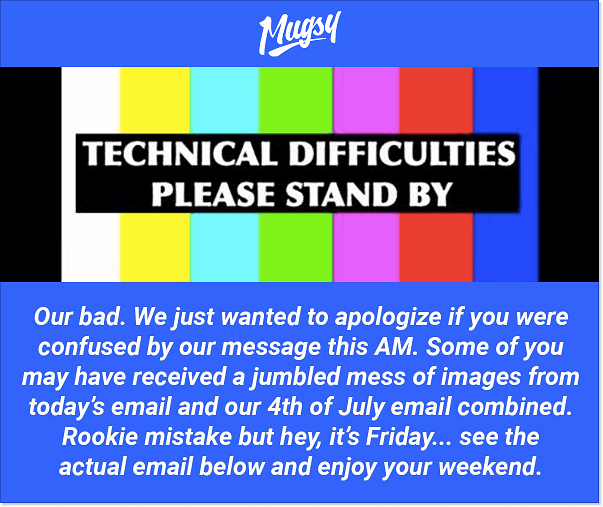
Mugsy is a great example: after sending a broken email with garbled images, they didn’t just resend the correct version, but owned the mistake with a brief, self-aware apology. That combination of accountability and lightness worked.
Another example worth mentioning is Airbnb. After a Harvard study exposed racial bias on the platform, CEO Brian Chesky sent a personal email to every user. That email came with a new anti-discrimination policy, an independent audit, and eventually the “We Accept” Super Bowl campaign. Two things caught my eye: 1) the CEO took personal responsibility in plain language and 2) the apology was backed by actual change, not just words.
How to craft a genuine apology: Key elements
Templates can be handy, but a truly effective apology is one that fits the specific issue and the specific customer. Here are some tips to help you create a meaningful apology:
- Be human and empathetic: When we start composing an apology email, our language often takes on a formal tone, laden with complex sentences and jargon. But the most critical element of any apology is sincerity. Begin by acknowledging the mistake or issue and expressing your genuine regret. Use straightforward language, and avoid being defensive.
- Explain the situation and take responsibility: Your customers appreciate knowing why the inconvenience occurred. And take ownership of the problem, even if it wasn’t entirely your fault. Common phrases like “We understand that we made a mistake” or “I want to apologize for any inconvenience” demonstrate accountability.
- Outline the solution and offer compensation (if applicable): Clearly state what you’re doing to resolve the issue or how you plan to prevent it from happening again. Consider offering compensation or a goodwill gesture if the situation calls for it. This could be a discount, a freebie, or an expedited service.
- Keep it concise: While it’s essential to be thorough, keep your apology concise. Avoid overly long and convoluted explanations.
- Edit and proofread: Finally, it’s always a must to take a moment to review and edit your genuine apology for clarity, grammar, and tone. A well-crafted message reflects professionalism.
Quick note!
Here’s a quick cheat sheet on how you can say “sorry for the inconvenience.” Which phrase to avoid and what to say instead 👇🏻
| Do NOT say that! | DO say that! |
|---|---|
| Sorry, can’t help it… | Huge apologies for this misunderstanding… |
| To be honest, I have no clue how to handle this, so sorry. | I understand you completely! Let me provide several alternatives… |
| It’s not my department. Why don’t you go ask another one? | If I were you, I would be frustrated too! Let me loop my colleague from another team in. He/she will help! |
Pity, and we are sorry for the inconvenience! |
I am on the same page with you here. Could you please provide some details… |
| Sorry for the inconvenience! Is it working now? | Thank you so much for your patience! The issue is completely taken care of. |
How your customer support team can handle sincere apologies
Frustrated customers want 3 things, and they want them immediately. Keep this in mind before crafting any response:
- Resolution: They want their issue fixed, and they want it fixed yesterday. Your reps should prioritize finding a solution.
- Respect: A frustrated person still wants to feel respected. Treating customers with respect is non-negotiable, even if they’re upset.
- Clear information: They want answers, not more questions. Ensure your reps provide clear, concise information without sending customers on a wild goose chase.
Just look at this informal and heartfelt apology from Kukuruza. Such a humane approach can easily win the hearts of your customers.

Knowing what to say is only half the job, but how you say it matters just as much. Train your reps to actually listen, not just wait for their turn to speak. Staying calm under pressure is part of that too: a composed response can de-escalate a tense situation faster than any script.
Speed matters as well. Nobody likes to wait, especially someone who is already frustrated with your product. Quick canned responses, even if it’s just to say, “We’re looking into this,” signal that someone’s paying attention. For example, with HelpCrunch, your team can set up and send responses like that in seconds, without sacrificing the human tone. Start your free 14-day trial and see how much smoother support gets.
Bottom line
Every customer relationship starts with a welcome message for customers, and how you handle the moments when things go wrong defines whether that relationship lasts. Your “sorry for the inconvenience” messages are actually an opportunity to win the customer back. Handled well, a sincere apology can build more trust than if the problem never happened (and that matters more than most businesses realize).
As you can see, I didn’t reinvent the wheel in our scenarios, it’s just ordinary words expressed in an offbeat way. Remember the basics: call a customer by name, be friendly, be specific, and be creative in solutions. And don’t make promises you can’t keep. Vague reassurances make things worse, not better.